

A B2B buyer recently asked us to evaluate two multi-head charging cable concepts:
- USB-C input to two USB-C outputs
- USB-C input to two USB-C outputs plus one Lightning output
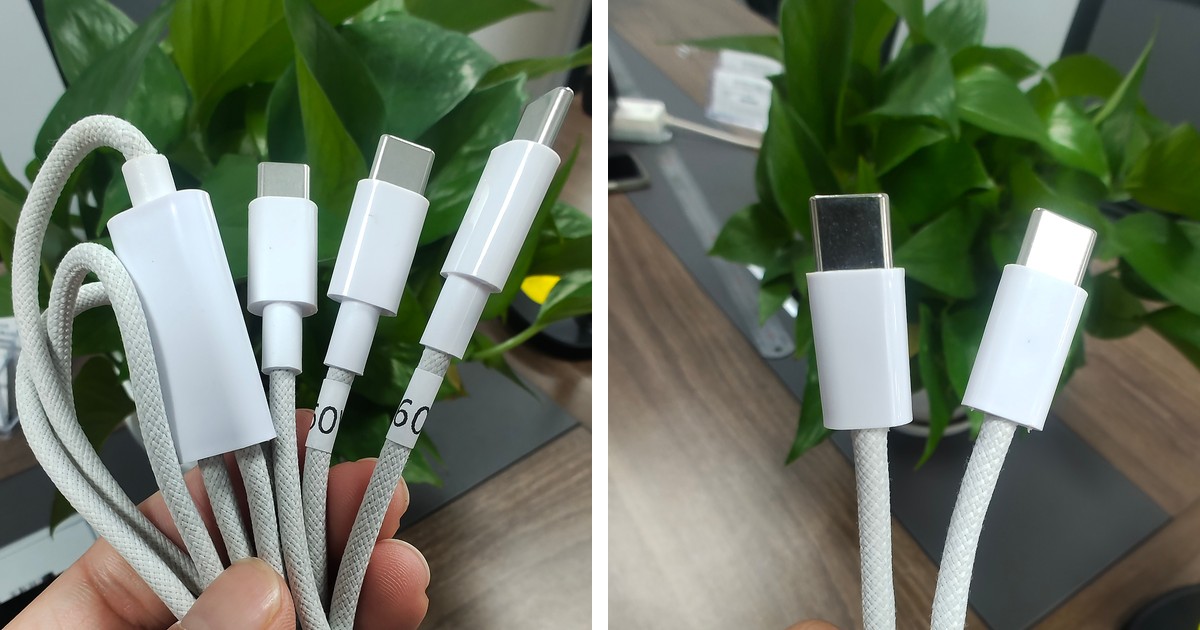
From the outside, the request looked straightforward: confirm the cable length, choose PVC or braided material, add the customer’s logo, and prepare a quotation.
Why the Concept Was More Complex Than It Looked
For a retailer or accessories brand, a multi-head charging cable can appear attractive:
- One cable for several devices
- Less cable clutter
- A convenient travel or desktop accessory
- A clear visual difference from an ordinary charging cable
However, adding connectors does not automatically create several independent fast-charging outputs.
The important questions were:
- Can every connector work at the same time?
- Can every connector fast-charge at the same time?
- What happens when a second or third device is connected?
- Does the output remain stable, or does one branch stop charging?
What Happened When Multiple Devices Were Connected
We reviewed the concept with an experienced charging-cable manufacturing partner. Different internal structures produced very different results.
USB-C to Dual USB-C Without a Control Board
This structure was not considered suitable for reliable multi-device fast charging.
When one connected device entered fast-charge mode, the second branch could not reliably operate as an independent charging output.
The problem was therefore not whether the cable shape could be produced. It was whether the expected charging function could be promised clearly and consistently.
USB-C to Dual USB-C With a Control Board
A version with a control board was more practical, but it still had important limitations.
Based on the available design reviewed for this project:
- One device could fast-charge when connected alone.
- When two devices were connected, the output could fall back to approximately 5V/3A shared charging.
- In some operating conditions, when one USB-C device entered fast-charge mode, the second output could stop charging.
The manufacturing partner had previously evaluated a similar concept, but the resulting user experience was not considered satisfactory enough to continue the original solution.
USB-C to Dual USB-C Plus Lightning
Adding a third connector made the power-control and charging behaviour more difficult to manage reliably.
The manufacturing partner concluded that the available USB-C plus USB-C plus Lightning structure was not stable enough to recommend for this project.
The concern was not the external appearance. The concern was whether the product could consistently deliver the multi-device charging experience a buyer might advertise to end users.
A More Practical USB-C Plus Lightning Option
A two-output USB-C plus Lightning version was considered more practical, provided that its limitations were communicated clearly.
- The USB-C connector could support fast charging when used alone.
- The Lightning connector could support fast charging when used alone.
- When both connectors were used together, the output would reduce to shared charging.
- A control board was still required.
This was a more realistic product direction, but it should not be marketed as simultaneous dual fast charging.
“Can Charge Two Devices” Is Not the Same as “Dual Fast Charging”
This distinction is important for brands, distributors and retailers.
A product description may say that two devices can be connected, but that does not automatically explain:
- Whether both devices can charge simultaneously
- Whether only one branch supports fast charging
- Whether the total available power is shared
- Whether the second device stops charging when the first enters fast-charge mode
- Whether performance changes between phones, tablets and laptops
If these points are not confirmed before ordering, a buyer may receive a product that is technically functional but commercially difficult to explain.
That can lead to:
- Misleading product claims
- Compatibility complaints
- Customer returns
- Negative product reviews
- Retail staff confusion
- Unstable repeat orders
Why We Did Not Simply Send a Price
It would have been easy to focus only on the visible requirements:
- Cable length
- PVC or braided material
- Black or white colour
- Customized logo
- Order quantity
But those details were not the main product risk.
The real risk was that the buyer could invest in samples, branding, packaging and inventory before discovering that the simultaneous charging behaviour did not match the original product concept.
We therefore clarified the functional limitations before treating the request as a normal quotation project.
The appearance was possible.
The expected multi-device fast-charging experience was not reliable enough.
For a B2B buyer, identifying this difference early is more valuable than receiving a fast price for a product that may create complaints later.
8 Questions to Confirm Before Ordering
Before comparing quotations for a multi-head charging cable, buyers should ask suppliers to confirm the complete usage scenario.
- Can every connector work at the same time?
- Can every connector fast-charge, or only one?
- What happens when the second device is connected?
- Is the available power shared between outputs?
- What is the simultaneous output, not only the single-port maximum?
- Does the product contain an active control board?
- Which phones, tablets or laptops have been tested?
- What charging claim can safely be printed on the packaging?
A cable advertised as “100W” may refer only to its maximum output when one compatible device is connected.
It does not automatically mean that two connected devices can each receive high-power fast charging.
What This Means for B2B Buyers
Product sourcing should not begin and end with:
“Can you make it, and how much does it cost?”
A more useful question is:
“What will the end user actually experience when every connector is being used?”
Product feasibility should be reviewed before buyers invest in samples, tooling, customized packaging or inventory.
Sometimes the right decision is to adjust the structure, simplify the charging claim, or select a more stable alternative.
At iTop Electronics, our role is not only to find a product that can be manufactured. We help buyers clarify whether the product can support the intended market claim and customer experience.
Planning a Charging Cable Project?
Share the devices you want to charge, the number of simultaneous outputs required, the target power, cable structure, expected quantity and proposed packaging claim.
We can help review whether the concept is practical before you move to samples, branding or mass production.